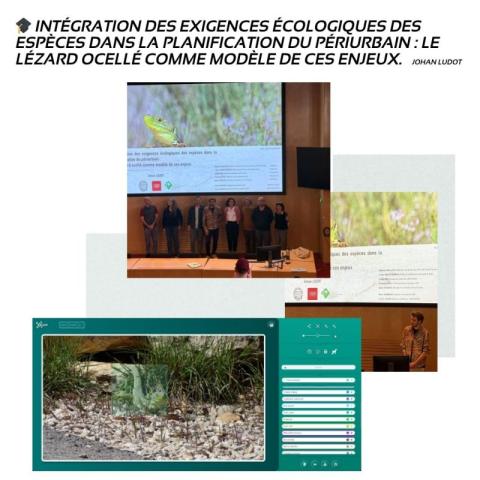
Yesterday, Sylvain Moulherat and Léa Pautrel attended the defense of this PhD thesis led by Johan Ludot, using the ocellated lizard (Timon lepidus), a protected and threatened species, as a model.
In peri-urban environments, the diffuse expansion of urbanization at the interface with agricultural and natural areas creates new landscape configurations. Species responses, both at the individual and population levels, depend on their life-history traits as well as on the spatial structure of these environments. This thesis aims to understand how to integrate these ecological requirements into spatial planning processes. As a cavity-dependent species, the ocellated lizard faces both opportunities offered by certain anthropogenic structures and constraints related to habitat fragmentation and artificialization. Along a Mediterranean urbanization gradient, this work analyzes, at multiple scales, the influence of habitat configuration, urbanization intensity, and landscape dynamics on species distribution, space use, connectivity, and population viability. To do so, it combines approaches from landscape genetics, individual behavior monitoring through radiotracking, and modeling tools for species distribution and population dynamics.
It is within this framework that our SimOïko and OCAPI tools were used.
OCAPI enables the management of camera trap data, facilitating its use in ecological studies and thereby improving the quality of the analyses produced.
A key question then arises: how can this ecological knowledge be integrated into operational planning tools?
SimOïko provides an answer by translating this knowledge into analyses that can be directly applied to planning. By incorporating ecological parameters such as survival, reproduction, and movement, it makes it possible to simulate population dynamics and to concretely assess the impact of landscape configurations on species viability and their dispersal capacities.
This work highlights the value of combining scientific approaches to better understand how living systems function—and, above all, to integrate this knowledge from the very early stages of project design (“design for nature”).
At TerrOïko, we are very pleased to have contributed to this thesis through the use of our tools.
Congratulations to Johan for this comprehensive and impactful work, as well as to all members of the jury and supervisors:
Aurélie Coulon, Benoit Charrasse, Sébastien Devillard, Francis Isselin, Solène Croci, Stéphanie Manel, Bjöern Reineking.