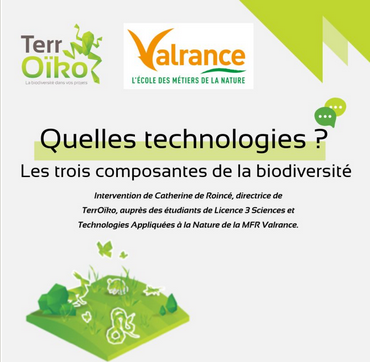
In this rainy month of February, Catherine de Roincé, director of TerrOïko, was invited to speak to third-year students in the Applied Sciences and Technologies for Nature program at MFR VALRANCE.
On the agenda: technological tools used to monitor biodiversity (flora and fauna).
Catherine offered to provide an overview of existing technologies to describe the three key components of biodiversity at the landscape scale:
- Its structure and land use
- Its composition, natural habitats, and associated plant and animal species
- Its functioning, ecological connectivity, and ecosystem services
Very quickly, the students were able to identify numerous tools for describing the structure and composition of landscapes.
But a key question has emerged: how do we analyze the functioning of a landscape?
The answers lie largely in modeling tools, such as SimOïko, which analyze the effect of a landscape’s structure and composition on the demographic dynamics of a species.
But that’s not all. Two other approaches, which are still underutilized, have also been highlighted:
- our favorite: landscape genetics, which allows us to study both population dynamics and dispersal at the same time
- GPS-based trajectory analysis for daily movements, migratory patterns, and sometimes dispersal
In conclusion, Catherine emphasized the importance of using technology in a sensible and moderate way. She noted that for decades, the field of ecological science has relied on analytical tools that yield robust results based on protocols grounded in human observations.
As demonstrated in Léa Pautrel’s dissertation, recently defended at TerrOïko, discrete analytical models remain fully effective, even when combined with sensors.
A big thank you to MFR Valrance and the students for the quality of our discussions and their scientific curiosity!