It was a few days ago, and it's still a moment we love!

After three years of work, our colleague Léa Pautrel defended her doctoral thesis in ecology at the University of Montpellier last week. She conducted her research at TerrOïko in partnership with the Center for Functional and Evolutionary Ecology (CEFE).

Want to watch or rewatch her defense? You can do so here  https://lnkd.in/dVAAb2XF.

Léa's research focused on the use of continuous-time hierarchical models for monitoring biodiversity with sensors. Here's a summary.

 mc-chamayou  

Digital tools or field inventories?

In reality, in most of our work, field data and the results of modeling or automated analysis are often closely combined.

There is a research project we are currently working on that is a perfect illustration of this.

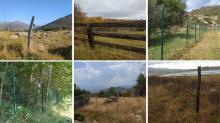
Launched in 2024 and named Polymor-FENCE, it aims to develop tools and methods to analyze and anticipate the impacts of fences on animal species and their movements.

 mc-chamayou  

Thesis defense

At TerrOïko since 2021 and a doctoral student in functional ecology at the University of Montpellier, Léa Pautrel has conducted her research at TerrOïko, in partnership with the Center for Functional and Evolutionary Ecology (CEFE) as part of a CIFRE thesis.
 

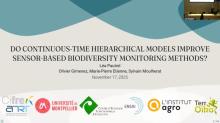
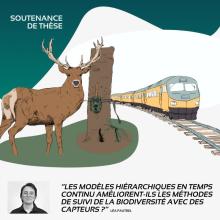
On November 17, Léa will present the results of three years of research and reflection on a central question: Can continuous-time hierarchical models improve methods for monitoring biodiversity using sensors?

 mc-chamayou  

Biodiversity indicators directly embedded in building BIM data are now possible.

Yesterday was the ceremony to announce the winners of the FEREC Corporate Foundation's 2025 call for projects. As winners of the 2024 edition, we were invited to present the results of the project we had been working on throughout the year.

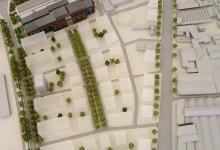
Called Optibionum, it focused on creating ecological indicators for evaluating building and infrastructure construction projects and integrating them into BIM tools

What did we do? A detailed report will be delivered in December, but here is a brief summary of our work.

 mc-chamayou  

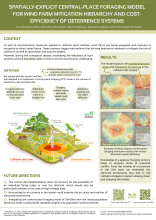
TerrOïko presents the SimOïko module “Central Place Foraging”

This week, we are attending the 8th Conference on Wind energy and Wildlife impacts - CWW2025, the leading international event on wind energy and its interaction with biodiversity, which is being held in Montpellier (France) until Friday.

As part of the poster sessions, we are presenting a special feature of our ecological simulation software SimOïko, specifically designed to analyze the risk of collision between flying species and wind turbines.

 mc-chamayou  

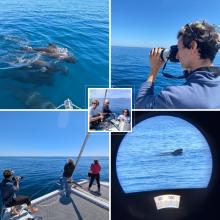
TerrOïko on a mission: meeting cetaceans in the Mediterranean

You think we spend all our time behind a computer?
Well, not quite.

The day-to-day work of our ecological engineers involves conducting research, analyzing data and carrying out studies on behalf of public and private players.

So yes, most of the time we have our hands in statistics, modeling and mapping tools, scientific literature...

But when data or knowledge are lacking, we sometimes have to go out and find them, in the field.

A few days ago, our colleague Victor Gauducheau, a specialist in marine environments, cast off for a little trip out to sea.

 mc-chamayou  

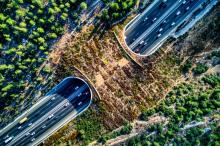
What will transport infrastructures need to look like in 2050 to be biodiversity-friendly?

This was the topic addressed today by our CEO Sylvain Moulherat at the FIRM25 event organized by FEHRL, the international association dedicated to road equipment research.

This presentation enabled him to go back over the Bison project, to which TerrOïko made a major contribution, and whose aim was to build a European roadmap for transport infrastructures that fully integrate ecological issues.

 mc-chamayou  

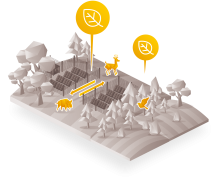
The Polymor-FENCE project is moving forward: we've got news for you!

We need to give you an update on our research project into fences and their ecological impact.

Launched in early 2024, the Polymor-FENCE project aims to analyze and understand the impact of fences associated with photovoltaic power plants on biodiversity and the ecological continuity of natural environments.

Using an integrated approach combining field observations, artificial intelligence and spatial modeling, the project is developing innovative tools designed to anticipate and mitigate these effects.

 mc-chamayou  

The PEP-BIOccIA Project: A First Workshop Towards a Shared Vision of Occitanie’s Natural Habitats

Last week marked the first workshop of the PEP-BIOccIA project.

As a reminder, this project aims to map natural habitats and predict species presence across the entire Occitanie region, in order to better plan for medium- and long-term biodiversity conservation. It is led by the Région Occitanie / Pyrénées-Méditerranée, CNRS (CEFE), Data Terra, OPenIG, and TerrOïko.

 mc-chamayou