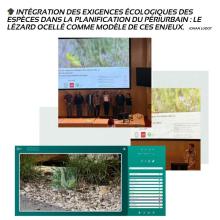
Yesterday, Sylvain Moulherat and Léa Pautrel attended the defense of this PhD thesis led by Johan Ludot, using the ocellated lizard (Timon lepidus), a protected and threatened species, as a model.
Digital tools or field inventories?
In reality, in most of our work, field data and the results of modeling or automated analysis are often closely combined.
There is a research project we are currently working on that is a perfect illustration of this.
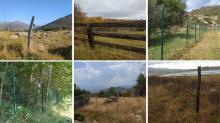
Launched in 2024 and named Polymor-FENCE, it aims to develop tools and methods to analyze and anticipate the impacts of fences on animal species and their movements.
We bring you news on the PEP-BIOccIA project
A few weeks ago, the PEP-BIOccIA project officially changed its name to Gaia predict.
The new name reflects the project's mission: to map natural environments, predict the presence of species in the Occitanie region, and better plan the preservation of biodiversity. The term “Gaia” refers to the Earth. As for Prédict, it underlines the project's focus on predictive analysis and decision support for the sustainable management of our biodiversity.
The Polymor-FENCE project is moving forward: we've got news for you!
We need to give you an update on our research project into fences and their ecological impact.
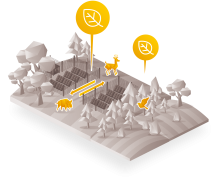
Launched in early 2024, the Polymor-FENCE project aims to analyze and understand the impact of fences associated with photovoltaic power plants on biodiversity and the ecological continuity of natural environments.
Using an integrated approach combining field observations, artificial intelligence and spatial modeling, the project is developing innovative tools designed to anticipate and mitigate these effects.
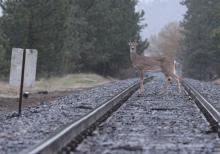
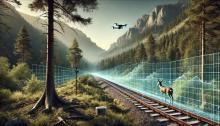
How can we help reduce the risk of collision between trains and wildlife?
Last week, our CEO Sylvain Moulherat was invited to present our work on the subject at the Via Fauna technical seminar.
Via Fauna is a project launched in 2017 by the Fédération Régionale des Chasseurs d'Occitanie (Regional Federation of Hunters), which has led to the development of tools and methods for better integrating ecological connectivity into land-use planning projects and urban planning documents.
The PEP-BIOccIA Project: A First Workshop Towards a Shared Vision of Occitanie’s Natural Habitats
Last week marked the first workshop of the PEP-BIOccIA project.
As a reminder, this project aims to map natural habitats and predict species presence across the entire Occitanie region, in order to better plan for medium- and long-term biodiversity conservation. It is led by the Région Occitanie / Pyrénées-Méditerranée, CNRS (CEFE), Data Terra, OPenIG, and TerrOïko.
PEP-BIOccIA: AI and the future of public service
Since a year ago, the Senate's Foresight Delegation has been focusing on AI and the future of public services. Their work has resulted in the publication of several reports, including one dedicated to environmental issues (*), which was released a few days ago.
The good news is that among the projects and tools cited as examples is the PEP-BIOccIA research project, led by the Occitanie / Pyrénées-Méditerranée Region, in collaboration with OPenIG, CNRS, and our team.
Modeling, AI, geospatial data, IoT sensors, digital twins... Do biodiversity professions really need all of this?
Let's start with two principles that are fundamental to us.
The picture of a flower, the sound of a bird. What's next?
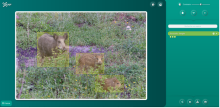
To make such data scientifically usable for training AI models or conducting statistical analyses they need to be annotated. This means enriching them with additional information, starting with identifying the species.
This was the focus of last week's EcoinfoFAIR conference, an annual event bringing together experts in informatics applied to ecology. Over three days, participants gathered at the CNRS Station for Theoretical and Experimental Ecology in Moulis.
How we're preparing for the arrival of digital twins for biodiversity
We often share our research and innovation work with you, but there’s something we haven’t explained.
What connects them all?
To discover one of the common threads of our R&D, join us during the week of November 4th at ADEME's premises in Sophia-Antipolis for the ITTECOP Days (infrastructure, territories, transport, energy, ecosystems, and landscape program).
Pagination
- Page 1
- Next page